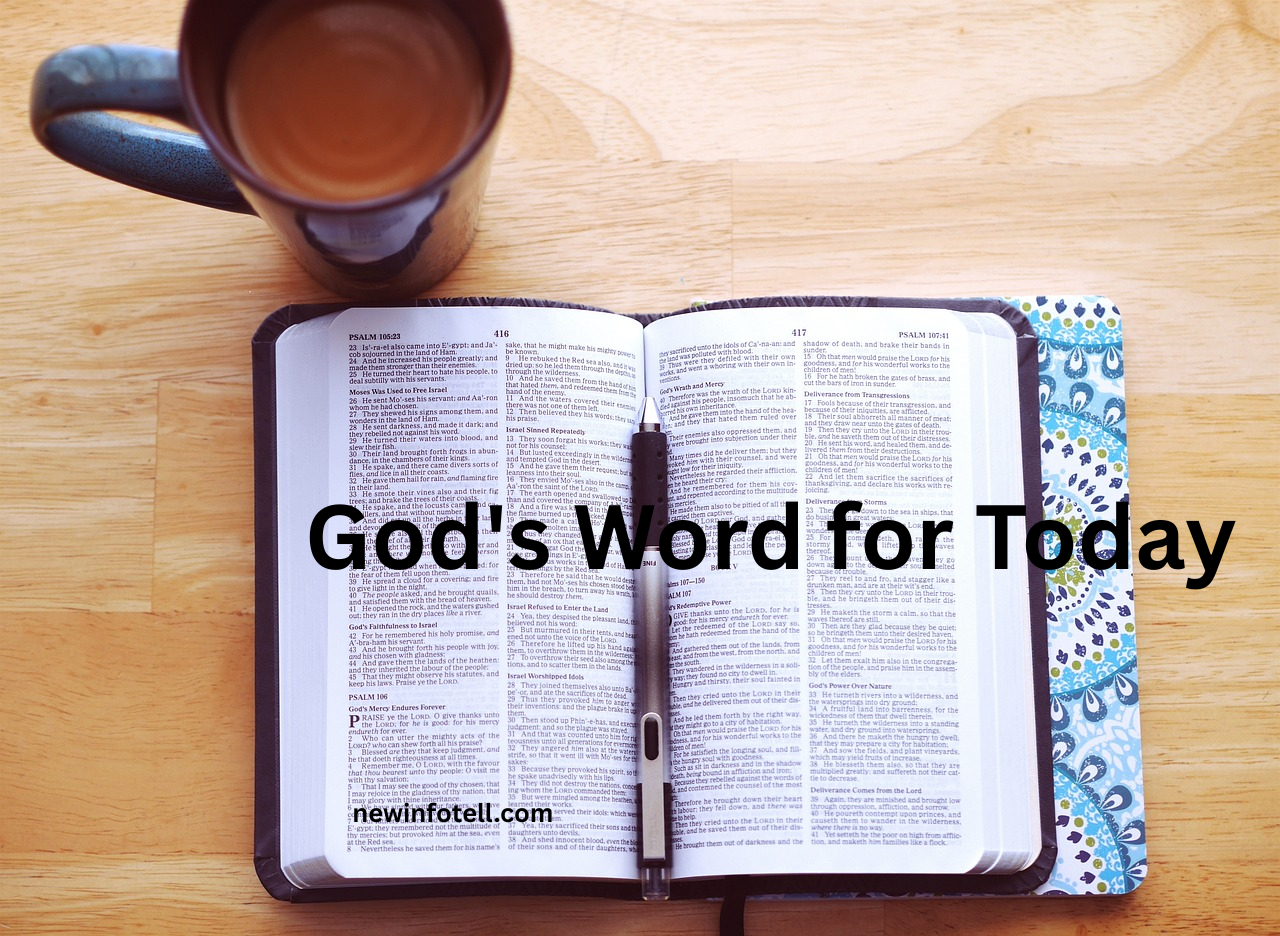
God’s Word for Today. Every single day, millions of people wake up carrying weight that the world around them cannot fully address. The executive navigating a career crisis at 3 a.m. The young mother battling postpartum anxiety in silence. The businessman drowning in debt, staring at spreadsheets that don’t balance. The college student questioning everything they were raised to believe. The elderly man sitting alone in a house that used to be full of life and laughter. The recovering addict, ninety days sober, wondering if the ground beneath them is finally solid.
Every one of them needs a word.
Not advice. Not algorithms. Not a motivational quote printed over a sunset photograph. A word — living, specific, authoritative — that reaches into the exact texture of their reality and speaks truth into it.
That is what God’s Word does. And that is what this article is for.
The Bible is not a religious artifact preserved behind glass for scholarly observation. It is what the writer of Hebrews calls “living and active, sharper than any two-edged sword, piercing to the division of soul and of spirit” (Hebrews 4:12). It is a living document — meaning it speaks with as much relevance and power into 2026 as it did in the first century. Its words land in the present tense because the God who breathed them exists outside of time and knows exactly where you are sitting as you read this sentence.
This article brings God’s Word to bear on the specific challenges, questions, and struggles that define life today. It is organized around the real-world areas where people most desperately need a word from heaven — career and purpose, mental health and anxiety, financial hardship, relationships, identity, and spiritual renewal. Each section delivers a core scripture, a substantive reflection, and a practical application point designed to move God’s Word from the page into your actual life.
Why God’s Word Is Uniquely Qualified to Speak Into Today
In a culture flooded with content — self-help books, online therapy platforms, personal development podcasts, life coaching programs, wellness apps, and productivity frameworks — it is worth asking a precise question: what does Scripture offer that everything else does not?
The answer is not that other resources are valueless. Many of them are genuinely helpful. But they all operate within the same fundamental limitation: they are human wisdom addressing human problems with human insight. They may be brilliant, rigorously researched, and beautifully articulated — but they are still working within the ceiling of what human beings can observe, analyze, and recommend.
Scripture operates from a different source entirely. The Apostle Paul writes in 2 Timothy 3:16–17 that “all Scripture is God-breathed and is useful for teaching, rebuking, correcting and training in righteousness, so that the servant of God may be thoroughly equipped for every good work.” God-breathed (theopneustos in Greek) — exhaled from the being of God Himself, carrying His authority and His infinite knowledge of the human condition into every word.
The God who breathed the Scriptures is the same God who designed the human mind, who created the economic systems through which financial hardship operates, who authored the relational dynamics that make marriages and friendships either flourishing or fracturing. When He speaks to these areas of life, He speaks as their Maker — with a precision and a depth that no human observer, however brilliant, can match.
This is why God’s Word for today is not a religious supplement to real life. It is the most practically relevant voice available to every person navigating the actual challenges of actual existence in 2026.
God’s Word for Your Career and Professional Life
Core Scripture: Colossians 3:23–24 “Whatever you do, work at it with all your heart, as working for the Lord, not for human masters, since you know that you will receive an inheritance from the Lord as a reward. It is the Lord Christ you are serving.”
Reflection
The modern professional landscape is one of the most anxiety-producing environments in contemporary life. The speed of technological disruption, the instability of industries that seemed permanent, the pressure of performance metrics, the looming reality of artificial intelligence reshaping entire career categories, and the exhausting competition of a global talent marketplace — all of these forces conspire to make work feel simultaneously overwhelming and purposeless.
Colossians 3:23–24 cuts through all of it with a reorientation so fundamental that it changes not just how you work, but why. The verse does not promise that your work will always be fulfilling, that your employer will always be fair, or that your career trajectory will be linear and upward. What it does promise is this: the ultimate audience for your work is not your manager, your performance review system, or your LinkedIn profile. It is the Lord Christ.
This means that the faithful work of an unnoticed employee in a mid-level role carries the same eternal weight as the celebrated work of a celebrated executive. It means that integrity in a small decision — when no one is watching and there is no professional incentive to do the right thing — is an act of worship. It means that a career transition, a season of underemployment, or a professional setback does not diminish the value of the work you are doing right now, because the One who evaluates it sees what the performance review cannot measure.
For those navigating major career decisions — whether to pursue an online professional certification, complete a graduate degree program, launch an entrepreneurial venture, or accept a senior leadership role — this verse provides the most important decision-making filter available: does this path allow me to work with all my heart as unto the Lord? If the answer is yes, the specific direction matters less than the posture of the heart that brings it.
Today’s Application: Before you open your laptop today, take sixty seconds to silently reorient the work that follows as work done for God. This practice, sustained daily, gradually transforms the entire meaning of your professional life from performance to worship.
God’s Word for Your Mental Health and Emotional Wellbeing
Core Scripture: Isaiah 26:3 “You will keep in perfect peace those whose minds are steadfast, because they trust in you.”
Reflection
Anxiety is the defining mental health challenge of the contemporary world. The statistics are staggering: anxiety disorders represent the most common category of mental health diagnosis globally, affecting hundreds of millions of people at any given moment. The economic cost of untreated anxiety and depression — in lost productivity, healthcare expenditure, and disability — runs into the trillions of dollars annually.
And yet for all the resources devoted to addressing this crisis — online therapy platforms, cognitive behavioral therapy programs, prescription mental health medication management, wellness apps, mindfulness curricula, and corporate mental health initiatives — the crisis continues to grow.
Isaiah 26:3 does not minimize the reality of anxiety or dismiss the value of evidence-based mental health treatment. But it points to a dimension of peace that those interventions alone cannot fully access: the supernatural, comprehensive peace (shalom shalom in Hebrew — the word doubled for maximum emphasis) that is the direct result of a mind that is steadfast in trust in God.
The key word in this verse is “steadfast.” The Hebrew word is samak — to lean, to rest your full weight on something. It describes the act of a person who stops trying to maintain their own balance through mental effort and instead leans their entire weight onto the character and faithfulness of God. It is not the peace that comes from having resolved all your problems. It is the peace that comes from knowing the One who holds all your problems — and trusting that He is better at holding them than you are.
This is not a replacement for professional mental health care. People navigating serious anxiety disorders, clinical depression, trauma-related conditions, and other mental health challenges should absolutely engage with licensed therapists, qualified psychiatrists, and evidence-based treatment programs. But beneath and behind every effective therapeutic intervention, the steadfast mind anchored in trust in God is the most durable foundation for lasting mental and emotional health that exists.
Today’s Application: Identify the specific anxiety that is most present in your mind today — name it, and then deliberately place it in God’s hands through prayer. Repeat this practice every time the anxiety resurfaces, treating each recurrence as a fresh opportunity to practice samak — leaning your full weight onto God rather than trying to balance it yourself.
God’s Word for Your Financial Challenges
Core Scripture: Luke 12:29–31 “And do not set your heart on what you will eat or drink; do not worry about it. For the pagan world runs after all such things, and your Father knows that you need them. But seek his kingdom, and these things will be given to you as well.”
Reflection
Financial anxiety is one of the most potent and corrosive forces in contemporary life. Whether you are managing consumer debt, navigating the complexity of bankruptcy proceedings, working with a financial recovery counselor to rebuild after economic collapse, or simply trying to build a sustainable financial plan in an economy defined by uncertainty — financial pressure has a unique capacity to occupy the mind with a relentless, background hum of worry.
Jesus addresses this directly in Luke 12. And His instruction is arresting: the frantic pursuit of financial security — running after provision the way “the pagan world” does — is not the way of the kingdom. This does not mean that financial planning is wrong, that working hard is unnecessary, or that debt management strategies are somehow unspiritual. Proverbs 21:5 explicitly commends diligent planning: “the plans of the diligent lead to profit.” Jesus is not attacking prudent stewardship. He is attacking the heart posture of anxious accumulation — the posture that says “my security depends entirely on my own ability to generate and control resources.”
The alternative He offers is not passivity — it is a reordering of priority. “Seek first the kingdom” — make the alignment of your life with God’s purposes the primary pursuit, and trust that the God who knows your needs will ensure they are met. This is not a prosperity gospel guarantee of wealth. The same Jesus who spoke these words also said “blessed are the poor in spirit” and lived His entire earthly life without a home of His own. It is, however, a direct promise from the most reliable source of economic wisdom in the universe: the God who created the concept of provision guarantees it to those who prioritize His kingdom.
For those working through serious financial hardship — whether engaging debt consolidation services, consulting with a bankruptcy attorney, rebuilding a credit history, or beginning a long-term wealth-building strategy — this verse offers the most important foundation available: financial healing, like all other healing, is most durable when it is built on a kingdom-first foundation rather than an anxiety-first one.
Today’s Application: Write down your single most pressing financial concern today. Beneath it, write Luke 12:31 as a declaration. Then make one specific, diligent, practical step toward addressing it — and bring that step to God in prayer as an act of kingdom-first stewardship rather than anxious striving.
God’s Word for Your Relationships and Family
Core Scripture: Ephesians 4:2–3 “Be completely humble and gentle; be patient, bearing with one another in love. Make every effort to keep the unity of the Spirit through the bond of peace.”
Reflection
Relationships are simultaneously the greatest source of human joy and the deepest source of human suffering. The same capacity for intimacy that makes love so profound is the capacity that makes betrayal, disappointment, and conflict so devastating. Every therapist’s waiting room, every divorce court, every family estrangement, and every broken friendship is testimony to the reality that human relationships, left to human devices alone, are extraordinarily fragile.
Ephesians 4:2–3 does not pretend that relational health is easy. The words “make every effort” acknowledge that unity requires active, sustained work — not passive good intentions. But it grounds that effort in four specific qualities: humility, gentleness, patience, and bearing with one another in love.
These are not personality traits that come naturally to most people under pressure. They are spiritual disciplines — the fruit of the Holy Spirit operating in a person who has surrendered the need to be right, to be validated, and to retaliate in kind. They are the qualities that Christian marriage counseling programs, faith-based family therapy, and premarital counseling curricula consistently return to as the foundational relational competencies that Scripture identifies as non-negotiable for flourishing relationships.
The phrase “bearing with one another” is particularly important in the context of long-term relationships. The Greek word (anechomenoi) suggests ongoing, active tolerance of the things in others that are genuinely difficult — not the pretense that difficulty does not exist, but the choice to carry the relational weight of another person’s limitations with patient, loving endurance. This is the biblical vision of what sustaining relationships look like over time: not effortless compatibility, but chosen, grace-fueled, persistent bearing of one another.
Today’s Application: Identify one person in your life with whom you are currently struggling to practice patience and gentleness. Pray specifically for that relationship today — not that the person will change, but that you will increasingly reflect these four qualities toward them.
God’s Word for Your Identity and Purpose
Core Scripture: Ephesians 2:10 “For we are God’s handiwork, created in Christ Jesus to do good works, which God prepared in advance for us to do.”
Reflection
The crisis of identity and purpose is one of the defining psychological and spiritual features of contemporary life. It spans generations — from adolescents struggling to establish a stable sense of self in the age of social media, to mid-career professionals experiencing the hollowness of achieved ambitions, to retirees navigating the loss of vocational identity, to young adults questioning whether their lives have any coherent direction at all.
No personal development framework, career coaching program, or online life coaching certification can fully answer the deepest questions that drive this crisis: Who am I, really? What am I here for? Does my specific, individual life matter in any ultimate sense?
Ephesians 2:10 provides an answer that is simultaneously cosmic in scope and intensely personal in application. The Greek word translated “handiwork” is poiema — the root of the English word “poem.” You are not a product of natural processes that happened to converge in a consciousness capable of asking these questions. You are a poiema — a deliberately crafted creative work by the most skilled artist in existence, designed with specific intention, given a specific voice, and placed in a specific moment in history to do works that were prepared for you specifically, before time began.
This does not mean your path will be obvious, linear, or immediately apparent. Discovering the “good works” prepared for you often requires the kind of sustained discernment work that spiritual direction, biblical counseling, and faith-integrated life coaching are specifically designed to facilitate. But it does mean you are not looking for a purpose that may or may not exist — you are uncovering one that was written for you before you were born.
Today’s Application: Ask God directly today — in prayer, in journaling, or in quiet reflection — to show you one specific “good work” He has prepared for you in this current season. It may not be grand. It may be a conversation, a phone call, a small act of service, a creative work, or an act of forgiveness. Be attentive to the answer throughout the day.
God’s Word for Seasons of Waiting and Uncertainty
Core Scripture: Isaiah 40:31 “But those who hope in the Lord will renew their strength. They will soar on wings like eagles; they will run and not grow weary, they will walk and not be faint.”
Reflection
Waiting is one of the most underrated spiritual disciplines in the Christian life — and one of the most difficult. In a culture defined by instant delivery, same-day results, and the expectation that discomfort should be resolved immediately, the experience of sustained uncertainty feels like failure rather than formation.
The prophet Isaiah speaks this word to a people who had been waiting for decades — waiting for national restoration, for political deliverance, for the fulfillment of promises that seemed to recede further into the horizon with every passing year. And his word to them is not “God is almost done” or “the wait will be short.” His word is about what happens to those who hope in the Lord while they wait.
The Hebrew word translated “hope” or “wait” is qavah — a word that comes from a root meaning to twist together, like the strands of a rope being braided into something stronger. Waiting in God is not passive endurance. It is an active, faith-exercising process of being twisted together with God’s purposes — of allowing the pressure and uncertainty of the waiting period to braid you into something stronger, more resilient, and more aligned with what He is building.
The result — soaring, running, walking without weariness or fainting — describes progressive levels of divine-energy engagement with life. The person who waits well on God does not merely survive their uncertain season. They emerge from it with a capacity for sustained, energized, purposeful engagement with life that those who avoided the waiting never develop.
This promise applies directly to anyone navigating the uncertainty of a major career transition, the waiting room of an answered prayer, the slow work of addiction recovery, or the incremental process of rebuilding financial stability after a collapse. The waiting itself, held in hope and trust, is doing something in you that cannot be accomplished any other way.
Today’s Application: Identify the primary area of your life where you are currently waiting — and consciously choose to engage that wait as a spiritual discipline rather than merely an endurance test. Pray Isaiah 40:31 over it today, claiming the promise of renewed strength for the specific challenge your waiting season presents.
God’s Word for Spiritual Renewal and Transformation
Core Scripture: Romans 12:2 “Do not conform to the pattern of this world, but be transformed by the renewing of your mind. Then you will be able to test and approve what God’s will is — his good, pleasing and perfect will.”
Reflection
Transformation is the deepest hunger of the human heart. Not merely improvement — not a slightly better version of who you already are — but genuine, fundamental change that produces a different person living a different kind of life.
Every personal development industry, every therapeutic modality, every self-help movement, every wellness program, and every life coaching curriculum is an attempt to satisfy this hunger. And many of them produce real, measurable change in specific areas of behavior and cognition. But Romans 12:2 points to a transformation that goes deeper than any human methodology can reach — because it begins in the mind at the level of fundamental perception rather than behavioral modification.
The Greek word translated “transformed” is metamorphoomai — the word from which we get “metamorphosis.” It describes the kind of change that a caterpillar undergoes in a chrysalis — not a caterpillar that has learned to move more efficiently, but a caterpillar that has become a fundamentally different kind of creature. Paul says this is what happens when the mind is genuinely renewed: not behavioral adjustment, but ontological transformation — becoming a different kind of person at the deepest level.
The mechanism of this transformation is the renewing of the mind — the progressive replacement of the world’s frameworks, values, and assumptions with the frameworks, values, and assumptions of Scripture. This is the work of sustained, serious, daily engagement with God’s Word — the kind of engagement that online biblical education platforms, structured Bible reading plans, theological study programs, and disciplined devotional practice are all designed to facilitate.
It is also the work of the Holy Spirit — who takes the words that the mind reads and transforms them from information into renovation. Which is why this kind of transformation cannot be achieved by intellectual Bible study alone, any more than it can be achieved by behavioral effort alone. It requires both the discipline of the mind and the power of the Spirit working together in a life that is daily surrendered to God.
Today’s Application: Identify one specific “pattern of this world” — a way of thinking about yourself, money, relationships, success, or worth — that you know does not align with Scripture. Write down what Scripture says instead. Commit to spending thirty days deliberately replacing the worldly thought with the scriptural one whenever it surfaces.
Building a Daily Practice Around God’s Word
Individual encounters with Scripture are valuable. But the transformation that Romans 12:2 describes, the steadfast mind of Isaiah 26:3, and the kingdom-first posture of Luke 12:31 are all sustained realities, not momentary experiences. They require daily, consistent engagement with God’s Word as a non-negotiable discipline rather than an occasional spiritual resource.
Here is how to build a God’s Word practice that actually changes your life:
Establish a consistent daily Scripture reading time. The specific time matters less than the consistency. Morning works well for many people because it establishes the orientation of the day before the world makes its competing claims on your attention. But the best time is the one you will actually keep. Many quality Bible reading plans, online devotional platforms, and faith-based study programs offer structured daily reading pathways that remove the decision-making burden from the practice — you simply show up and follow the plan.
Move from reading to reflection. Reading Scripture and reflecting on Scripture are different activities. After reading a passage, pause and ask three questions: What does this text say? What does it mean in its original context? What does it mean for my life today? This simple three-step process — used widely in faith-based personal development curricula, Christian life coaching frameworks, and biblical discipleship programs — moves Scripture from the surface of the mind into the deeper layers where transformation actually takes place.
Apply before you continue. James 1:22 warns against being a hearer who does not act — a person who looks at their reflection in a mirror and immediately forgets what they look like. Before you close your Bible or your devotional app, identify one specific application: one way the text you have just read calls you to think differently, act differently, pray differently, or relate differently in the next twenty-four hours.
Invest in tools that deepen your engagement. A quality study Bible, a biblical commentary series, an online theological education resource, or a structured faith-based discipleship course can dramatically increase the depth of your daily engagement with Scripture. The investment in quality biblical study tools is among the highest-return spiritual investments available — because everything in the Christian life is downstream from the quality of your engagement with God’s Word.
Find a community that does this together. Ecclesiastes 4:9 says two are better than one. A small group, an accountability partnership, a church community, or an online faith-based learning community that reads, discusses, and applies Scripture together multiplies the individual impact of personal Bible study through shared insight, mutual accountability, and corporate discernment.
Final Thoughts: The Word That Does Not Return Empty
Isaiah 55:11 contains one of the most remarkable promises in the entire Bible about the nature of Scripture: “So is my word that goes out from my mouth: It will not return to me empty, but will accomplish what I desire and achieve the purpose for which I sent it.”
Read also: 40 Bible Verses About Repentance: God’s Path to Restoration, Freedom, and New Life
God’s Word does not fail. It does not lose its effectiveness over time. It does not have an expiration date. The word that sustained Abraham in an unknown land, that strengthened David in a cave, that comforted Paul in a prison, that gave hope to a slave church in the Roman empire — that same word is alive and active and fully potent in your specific, complicated, twenty-first century life right now.
The executive at 3 a.m. The young mother in silence. The businessman staring at unbalanced spreadsheets. The student questioning everything. The man alone in the quiet house. The recovering addict on day ninety. Every one of them has access to a word that knows them better than they know themselves, loves them more deeply than they have yet experienced, and is actively working to accomplish a purpose in their lives that will outlast every difficulty they are currently navigating.
Open it. Read it. Reflect on it. Apply it. Return to it tomorrow.
God’s Word for today is waiting for you.
Share the article with others if you find it helpful.