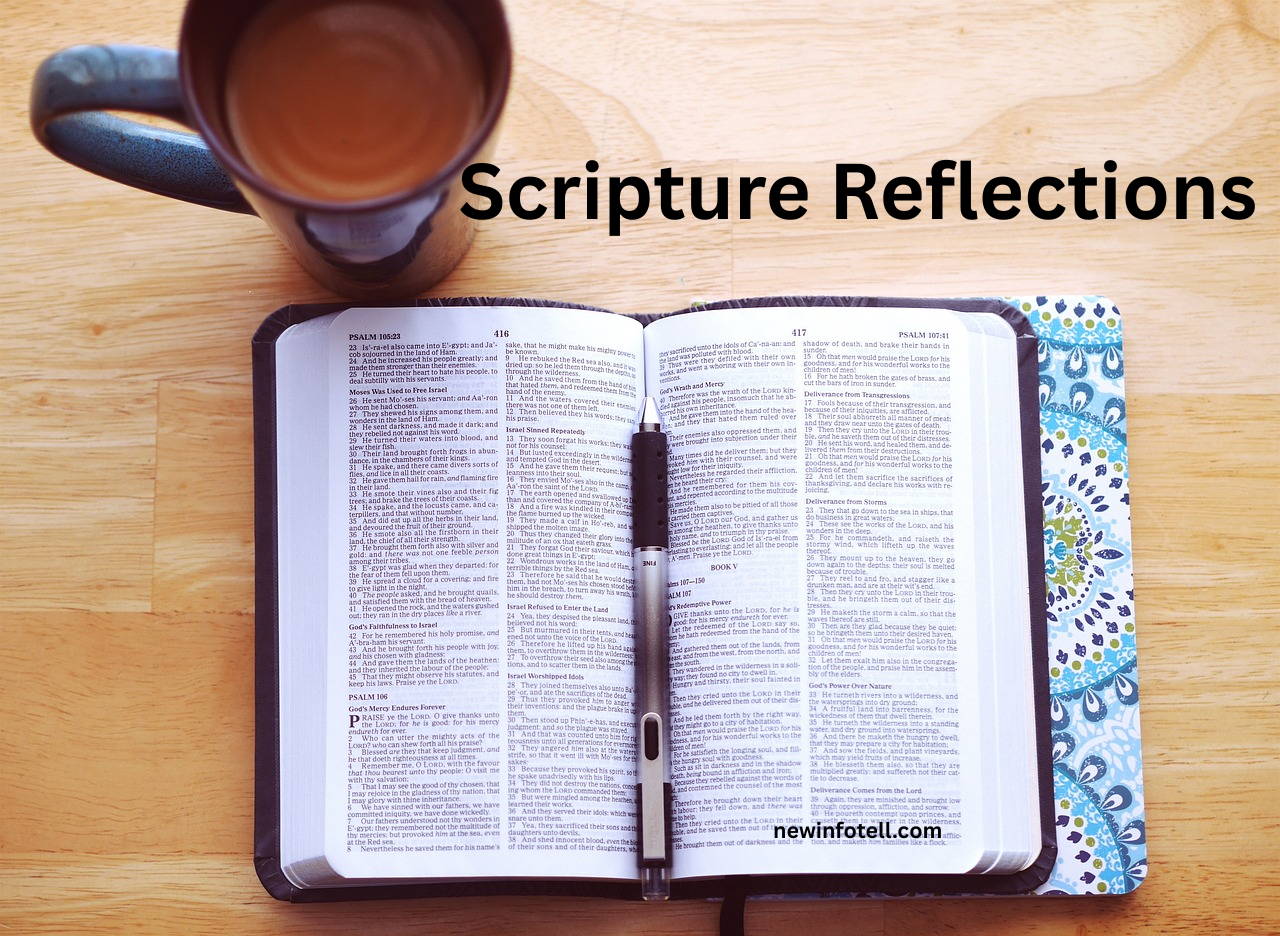
Scripture Reflections. In a world defined by relentless noise, digital distraction, and mounting pressure, millions of Christians across the globe are returning to one ancient, transformative practice: Scripture reflection. Whether you are a lifelong believer, a new Christian exploring your faith, or someone in the middle of a profound spiritual search, sitting with God’s Word — slowly, intentionally, and prayerfully — has the power to renew your mind, restore your peace, and redirect your life.
Scripture reflections are not simply about reading the Bible from cover to cover. They are about encountering God in the text, allowing His Word to speak directly into your circumstances, your fears, your questions, and your calling. This guide explores the theology, practice, and life-changing benefits of Scripture reflection, and offers practical tools, resources, and devotional strategies that will help you build a sustainable, deeply personal relationship with the living Word of God.
What Are Scripture Reflections?
Scripture reflections are the practice of reading, meditating on, and personally applying passages from the Bible in a deliberate, prayerful, and unhurried way. Unlike academic Bible study — which focuses primarily on historical context, original language, and theological analysis — Scripture reflection is an interior, devotional practice that invites you to ask: what is God saying to me through this passage, right now, in this season of my life?
The practice draws on a rich tradition within Christian spirituality. The ancient monastic method known as Lectio Divina — Latin for “sacred reading” — involves four movements: reading the text slowly (Lectio), meditating on a word or phrase that stands out (Meditatio), responding to God in prayer (Oratio), and resting quietly in God’s presence (Contemplatio). This method, practiced by Christians for over fifteen centuries, remains one of the most widely used frameworks for Scripture reflection in both Catholic and Protestant traditions today.
Scripture reflection is also closely aligned with biblical meditation — the practice commanded in Joshua 1:8, where God instructs Joshua to meditate on the Book of the Law day and night so that he may be careful to do everything written in it. Unlike secular mindfulness meditation, biblical meditation is not about emptying the mind. It is about filling the mind with God’s truth and allowing that truth to sink deep into the heart, transforming belief, behavior, and identity from the inside out.
The Spiritual and Mental Health Benefits of Daily Scripture Reflection
The benefits of regular Scripture reflection extend far beyond the spiritual realm. A growing body of research in the fields of psychology, neuroscience, and integrative health confirms that consistent engagement with contemplative spiritual practices — including devotional reading, prayer, and meditation — produces measurable positive effects on mental health, emotional regulation, and overall wellbeing.
Individuals who practice daily Scripture reflection consistently report reduced levels of anxiety and depression, improved emotional resilience, greater clarity in decision-making, stronger relational health, and a more stable sense of identity and purpose. Christian counselors and licensed therapists who integrate faith-based approaches into their clinical practice frequently recommend devotional Bible reading and Scripture journaling as therapeutic tools for clients navigating grief, trauma, relationship breakdown, addiction recovery, and major life transitions.
From a neurological perspective, the regular practice of contemplative reading and meditation has been shown to activate the prefrontal cortex — the area of the brain responsible for complex decision-making, empathy, and emotional regulation — while simultaneously reducing activity in the amygdala, which governs the stress and fear response. When Christians engage in Scripture reflection, they are not only nourishing their souls; they are literally reshaping the neural architecture of their brains in ways that support better mental and emotional health.
For Christians navigating seasons of grief, burnout, career uncertainty, marital difficulty, or spiritual dryness, Scripture reflection provides an anchor that secular wellness practices simply cannot offer: the living presence of a personal God who speaks, comforts, guides, and restores.
How to Begin a Daily Scripture Reflection Practice
Starting a Scripture reflection practice does not require theological training, an expensive study Bible, or hours of free time. It requires only a willing heart, a quiet space, and a commitment to showing up consistently. Here is a practical framework for beginning your daily practice.
Choose a specific time and place. Consistency is the foundation of any spiritual discipline. Whether you prefer early morning before the household wakes, a quiet lunch break, or a reflective evening hour before bed, designating a regular time and a quiet, comfortable space signals to your mind and spirit that this time is set apart for God.
Select a passage intentionally. You may choose to work through a book of the Bible systematically, follow a structured daily devotional reading plan, use a Scripture reflection journal or guided devotional, or engage with the lectionary readings of your church tradition. Bible apps such as YouVersion, Logos Bible Software, and the Bible Gateway platform offer structured reading plans, audio Bible access, and devotional content that can support your daily practice.
Read slowly and repeatedly. Unlike ordinary reading, Scripture reflection is not about covering ground — it is about going deep. Read your chosen passage two or three times, each time listening for a word, phrase, image, or sentence that seems to stand out, catch your attention, or speak to your current circumstances.
Sit with what arises. Once a particular word or phrase has drawn your attention, resist the urge to immediately analyze or explain it. Instead, stay with it. Repeat it quietly in your mind. Ask God what He wants to say to you through it. Allow the text to question you, challenge you, comfort you, or call you.
Respond in prayer and journaling. Scripture reflection naturally flows into prayer — a direct, honest, personal conversation with God in response to what you have read. Many believers also maintain a Scripture reflection journal in which they write out the passage, record what stood out to them, note what they believe God is saying, and document how they intend to respond. Journaling deepens the reflective process, creates a spiritual record of your journey, and makes it easier to recognize patterns of God’s guidance over time.
Close with a commitment. Every Scripture reflection should end with a concrete, practical response — one specific way you will apply what you have received from the text to your life that day. This is the essence of being, as James 1:22 instructs, “doers of the word and not hearers only.”
Scripture Reflection Themes for Every Season of Life
One of the greatest gifts of the Bible is its breadth. No matter what you are facing — joy or sorrow, success or failure, clarity or confusion, abundance or loss — there is a portion of Scripture that speaks directly into that experience. The following themes offer entry points for reflection across the full spectrum of human experience.
For anxiety and mental health struggles, the Psalms offer unparalleled honesty and comfort. Psalm 23, Psalm 46, Psalm 91, and Psalm 139 are perennial anchors for those walking through fear, uncertainty, and emotional pain. Philippians 4:6-7 — “Do not be anxious about anything, but in every situation, by prayer and petition, with thanksgiving, present your requests to God” — is one of the most reflected-upon passages by Christians navigating anxiety disorders, panic, and worry.
For grief and loss, passages such as John 11 — the account of Jesus weeping at the tomb of Lazarus — offer the profound comfort of a God who enters fully into human suffering. The lament psalms, including Psalm 22 and Psalm 88, give language to the experience of abandonment and pain in ways that validate rather than minimize grief.
For major life decisions — including career transitions, financial planning, marriage, relocation, and vocation — Proverbs 3:5-6, Romans 12:1-2, and Jeremiah 29:11 provide a framework for trusting God’s guidance when the path ahead is unclear. Christians in seasons of significant professional or financial decision-making often find that Scripture reflection opens a dimension of wisdom that no business course, financial advisor, or career coach alone can provide.
For spiritual dryness and doubt, the Gospel of John — particularly chapters 14 through 17, known as the Farewell Discourse — offers some of the most intimate and sustaining words Jesus spoke to His disciples. Honest engagement with the doubts of Thomas, the questions of Philip, and the failures of Peter creates space for believers to bring their own uncertainty to God without shame.
For personal renewal and transformation, Romans 8, Ephesians 1-3, and the Sermon on the Mount in Matthew 5-7 offer extended passages that repay weeks or months of careful, devotional engagement.
Tools, Resources, and Communities That Support Scripture Reflection
The modern Christian has access to an extraordinary range of tools and resources for deepening their Scripture reflection practice. Bible study software platforms such as Logos Bible Software and Accordance offer advanced research tools alongside devotional reading features that cater to both scholarly and contemplative approaches to the text.
Guided devotional books — including classics such as Oswald Chambers’ My Utmost for His Highest, C.S. Lewis’ Reflections on the Psalms, Eugene Peterson’s A Long Obedience in the Same Direction, and the annually published Upper Room Disciplines — provide structured frameworks for daily reflection that many believers find invaluable, particularly during seasons of spiritual dryness or life transition.
Online Christian communities on platforms such as Bible Gateway, Crosswalk, and Desiring God offer curated Scripture reflection content, topical devotional archives, audio sermons, and guided prayer resources that support consistent daily practice. Many churches and Christian counseling centers also offer small group Bible study programs, spiritual direction services, and faith-based wellness programs that center on communal Scripture reflection and accountability.
For those interested in integrating Scripture reflection with broader wellness and mental health practices, faith-based therapy platforms and Christian counseling services are growing rapidly. These services combine licensed clinical therapy with biblical counsel, spiritual direction, and devotional practice — providing an integrated approach to healing that addresses body, mind, and spirit simultaneously.
Scripture Reflection and Christian Education
Scripture reflection is not only a personal devotional practice — it is also foundational to Christian education at every level. Sunday school curricula, small group discipleship programs, homeschool Bible programs, Christian school devotional practices, and seminary spiritual formation courses all center on structured, guided engagement with the biblical text.
Parents raising children in the Christian faith increasingly recognize that teaching Scripture reflection as a skill — rather than simply exposing children to Bible stories — produces deeper, more durable faith formation. Resources such as family devotional guides, children’s Scripture journals, and age-appropriate Lectio Divina adaptations are growing in popularity among Christian families committed to multi-generational faith transmission.
Christian educators, homeschool consultants, and faith-based academic institutions have developed rich curricula around Scripture reflection that align with both spiritual formation goals and academic language arts and critical thinking standards, making the practice valuable across educational and pastoral contexts.
Integrating Scripture Reflection With Christian Counseling and Mental Health Care
The relationship between Scripture reflection and mental health care is one of the most significant and growing areas of conversation within both the Christian community and the broader mental health field. Licensed Christian counselors, clinical social workers, marriage and family therapists, and addiction recovery specialists increasingly recognize the therapeutic power of structured engagement with Scripture as a complement to conventional clinical treatment.
Faith-based online therapy platforms, Christian counseling centers, and telehealth mental health services that integrate biblical principles into evidence-based treatment modalities are experiencing significant growth, particularly in the wake of increased awareness around anxiety, depression, trauma, grief, and relationship crisis. Many insurance plans now cover sessions with licensed Christian counselors, making faith-integrated mental health care more financially accessible than ever before.
Scripture reflection practices recommended within a therapeutic context — including guided meditation on specific passages, gratitude journaling drawn from biblical themes, and structured Lectio Divina exercises — have demonstrated clinically meaningful outcomes in reducing symptoms of anxiety and depression, increasing psychological resilience, and supporting the recovery process for individuals navigating substance use disorders, relational trauma, and major life transitions.
Frequently Asked Questions About Scripture Reflections
How long should a Scripture reflection session last? Even ten to fifteen minutes of intentional, unhurried engagement with a single passage can be profoundly transformative. Quality of attention matters far more than quantity of time.
Do I need theological training to reflect on Scripture? No. Scripture reflection is an accessible practice for every believer regardless of educational background. A willing, open heart is the only prerequisite.
What is the difference between Bible study and Scripture reflection? Bible study tends to be analytically focused — understanding the text’s historical, grammatical, and theological meaning. Scripture reflection is devotionally focused — encountering God personally through the text and applying its truth to your inner life.
Can Scripture reflection help with anxiety and depression? Many Christian counselors and mental health professionals integrate Scripture-based practices into treatment for anxiety and depression. While Scripture reflection is not a clinical substitute for professional mental health care, it is a powerful complementary practice that many people find profoundly stabilizing.
How do I choose which Scripture to reflect on? You can follow a structured reading plan, use a devotional guide, work through a book of the Bible sequentially, or allow the prompting of the Holy Spirit to draw you to a particular passage in response to your current circumstances.
Conclusion: Let the Word Dwell Richly in You
Colossians 3:16 invites believers to “let the word of Christ dwell in you richly.” Scripture reflection is precisely that invitation made practical — a daily, intentional, prayerful dwelling in the living Word of God that transforms the reader from the inside out. In a culture that offers an endless supply of noise, distraction, and anxiety, the ancient practice of sitting quietly with Scripture remains one of the most countercultural, life-giving, and genuinely transformative choices a person can make.
Whether you are just beginning your devotional journey or seeking to deepen a practice you have maintained for decades, the Word of God is inexhaustible in its depth, its comfort, its challenge, and its grace. There is always more to discover, always more to receive, and always more of God to encounter in the text that has sustained, shaped, and saved lives across every generation of human history.
Begin today. Open the Word. Sit quietly. Listen. And let God speak.
Share the article with others if you find it helpful.